In today’s fast-paced digital landscape, having an online presence alone is no longer enough; you need to stand out. There are numerous ways to achieve this online, but if you want to foster sustainable growth, building your organic search presence is essential. With the boom of Large, Language Model assisted search engines, we entered a new phase of Search Engine Optimisation, SEO 2.0 if you will.
There are multiple elements to SEO 2.0, and in this article, we’ll examine the main three elements, defining what they are and their respective uses. Welcome to the SEO 2.0: The Definitive Guide to SEO, AEO and GEO.
Before we get stuck, let’s define what is SEO? What is AEO? What is GEO?
Definition: SEO (Search Engine Optimisation) is about making your website and content rank highly in search engines like Google, Bing, and Yahoo.
Definition: AEO (Answer Engine Optimisation) focuses on ensuring that your content is used to answer questions and is perceived as the natural progression of SEO, as the way people use search engines has evolved.
Definition: GEO (Generative Engine Optimisation) is a relatively new term that focuses on tactics to optimise your content for generative tools like ChatGPT, Gemini, Co-Pilot, and Google’s new AI Mode.
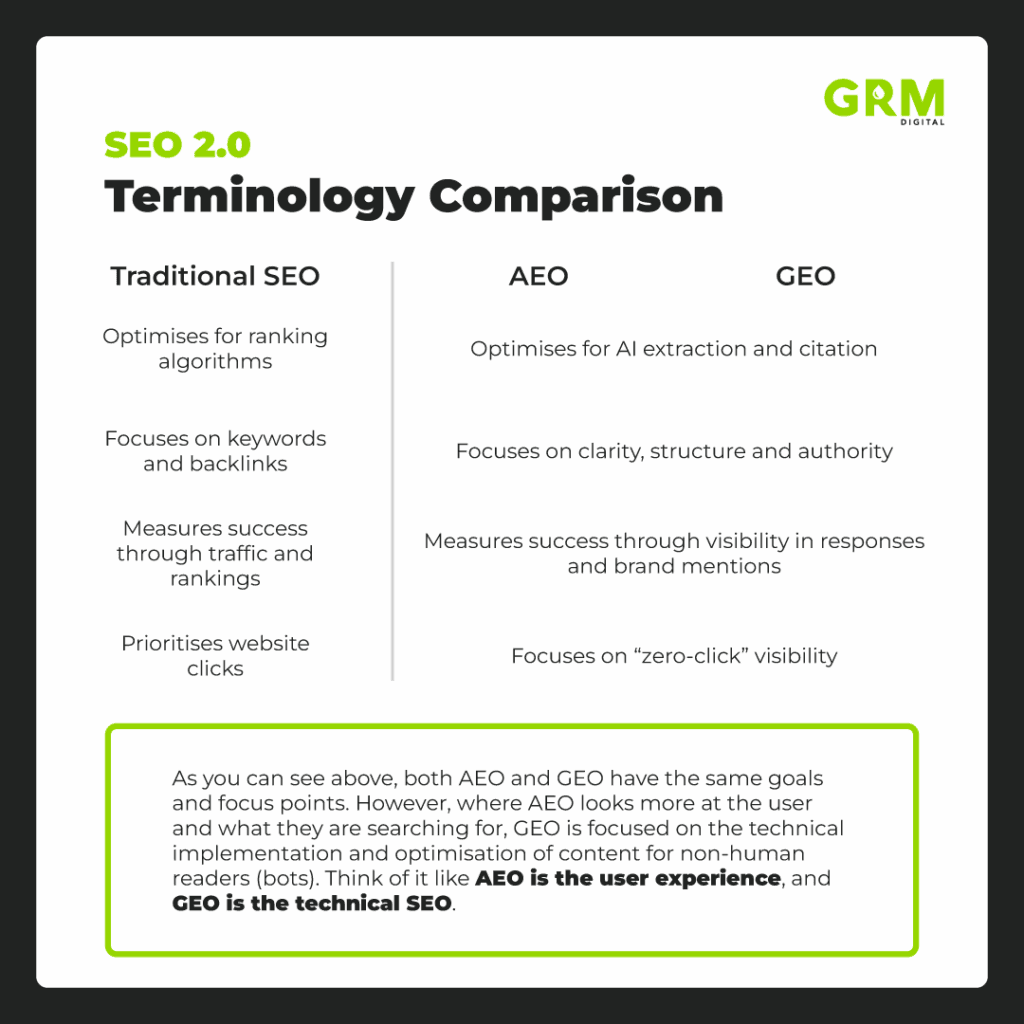
Tools like Google Assistant, Siri, and even the new era of search engines, such as Microsoft Co-Pilot and Google Gemini/AIMode, are all built around a question-and-answer mechanism. The answers provided are generated using generative AI systems, all of which are powered by large language models. In order for these systems to provide a generative response, they must use a generative AI. With both terms, AEO and GEO, being relatively new, and because both tactics have a substantial amount of crossover, it’s easy to get confused as to what they are intended for.
For a more visual breakdown of these terms, check out our LinkedIn post here.
This article will demystify these essential components of digital marketing so that you can elevate your brand’s visibility and engagement. By understanding these three powerful strategies, you’ll unlock the secrets to driving traffic, generating leads, and ultimately achieving digital success with organic search. Dive in and discover how to transform your online strategy into a thriving digital powerhouse!
Understanding SEO: The Foundation of Online Visibility
Search Engine Optimisation, or SEO, is the cornerstone of any digital marketing strategy. It involves the process of improving your website to increase its visibility when people search for products or services related to your business on search engines like Google, Bing, and Yahoo. The higher your pages rank in search results, the more likely you are to attract attention and bring prospective and existing customers to your business.
SEO isn’t just about building search engine-friendly websites; it’s also about making your site better for people. It encompasses a range of techniques and practices designed to enhance your website’s usability, speed, and overall user experience. Through keyword research, content creation, and technical adjustments, SEO aims to make your website more relevant and authoritative in the eyes of search engines. This relevance and authority translate into higher rankings and more visibility.
Moreover, SEO is an ever-evolving field. Search engines frequently update their algorithms to provide better user experiences. As a result, staying up-to-date with the latest SEO trends and best practices is crucial. Whether it’s mastering the art of creating high-quality content, understanding the importance of backlinks, or optimising for mobile users, a solid understanding of SEO principles is indispensable for any business looking to thrive online.
What is AEO and Its Role in Digital Marketing?
Answer Engine Optimisation (AEO) represents the next evolution in search engine optimisation. As digital assistants like Siri, Alexa, and Google Assistant become more prevalent, users are increasingly seeking instant, concise answers to their queries. AEO focuses on optimising content so that it provides direct, immediate answers to these voice-activated searches. This shift from keyword-based searches to question-based queries necessitates a different approach to content creation.
AEO is all about understanding the intent behind user queries and structuring your content to meet those needs. This involves leveraging structured data, such as schema markup, to help search engines understand the context and meaning of the content on your pages. By doing so, you increase the chances of your content being selected as a featured snippet or answer box, which are highly coveted positions in search results.
The rise of voice search has made AEO a critical component of a modern digital marketing strategy. Unlike traditional text searches, voice queries are often longer and more conversational. This means that businesses need to create content that answers specific questions and is easily digestible by voice search technology. By focusing on AEO, you can ensure that your content is not only found but also favoured by digital assistants, thereby reaching a broader audience in the process.
Exploring GEO: Local Optimisation for Global Reach
GEO is not only a new term but also an old one. In the world of SEO, GEO was previously a phrase used to mean Geographical Engine Optimisation or localisation.
Geographic Engine Optimisation (GEO) is all about optimising your content to ensure it reaches the right audience, regardless of their location. In an increasingly globalised world, local SEO has become more important than ever. GEO focuses on optimising your website to appear in local search results, which is crucial for businesses that operate in specific geographic areas or want to attract customers from particular regions.
Local SEO involves various strategies, including creating location-specific content, optimising your Google My Business listing, and building local citations. By doing so, you can ensure that your business appears in local search results when users search for products or services in your area. This is particularly important for small businesses that rely on local customers for their revenue.
Furthermore, GEO is not just about local businesses. Even large, global companies can benefit from local SEO by tailoring their content and marketing efforts to specific regions. By understanding the unique needs and preferences of different geographic markets, you can create more targeted and effective marketing campaigns. This localised approach can help you build stronger connections with your audience, ultimately leading to increased engagement and sales.
A new form of GEO: Generative Engine Optimisation
GEO also has a secondary meaning. In recent months, GEO has been used more frequently to mean “Generative Engine optimisation”. GEO, in this sense, has a lot of crossover with AEO and traditional SEO but with a core goal of pushing your content into generative tools like Google Gemini, ChatGPT, and Midjourney. This term is still new, and different people have different interpretations of the phrase.
This form of GEO is primarily focused on supporting the learning process of the LLM (Large Language Models) and AI that powers these generative tools. GEO has its place when it comes to content production, especially with the rise of AI Co-pilots and local/non-cloud, intranet-based AI search functions. Having correctly optimised content for your AI will allow it to perform better and serve the correct content during a query.
For the remainder of this article, when we reference GEO, we will specifically be referring to Generative Engine Optimisation rather than Geographical Engine Optimisation.
The Interconnection Between SEO, AEO, and GEO
While SEO, AEO, and GEO each have their unique aspects and focuses, they are all interconnected and work together to create a comprehensive digital marketing strategy. Understanding how these elements complement each other can help you develop a more effective and cohesive online marketing strategy.
SEO lays the groundwork by ensuring your website is optimised for search engines and users alike. This involves technical aspects, such as site speed and mobile optimisation, as well as content creation and keyword research. By building a strong SEO foundation, you create a website that is more likely to rank well in search results, providing a solid base for AEO and GEO efforts.
AEO builds on this foundation by focusing on providing direct, concise answers to user queries, particularly for voice searches. By optimising your content for voice search and leveraging structured data, you can increase your chances of appearing in featured snippets and answer boxes. This not only improves your visibility but also enhances the user experience by providing quick and accurate answers to their questions.
GEO further enhances your digital marketing strategy by ensuring your content reaches the right audience using modern-day search engines and AI-powered query tools. By optimising your content for generative tools, you’re ensuring your content will continue to be served by the likes of Google’s AI mode, Chatgpt and summary tools in Google Search and Bing Search.
Together, SEO, AEO, and GEO form a powerful trifecta that can help you achieve digital success by driving traffic, generating leads, and ultimately increasing sales.
Key Strategies for Effective SEO
To achieve effective SEO, several key strategies must be implemented. The first and foremost is keyword research. Understanding what your target audience is searching for and incorporating those keywords into your content is crucial. Tools like Google Keyword Planner, Ahrefs, and SEMrush can help you identify high-volume, low-competition keywords that can drive traffic to your site.
Another essential strategy is creating high-quality content. Content is king in the world of SEO, and producing valuable, engaging, and informative content can significantly boost your rankings. This includes blog posts, articles, videos, infographics, and other types of content that provide value to your audience. Regularly updating your content and ensuring it remains relevant is also essential for maintaining high rankings.
Technical SEO is another critical aspect of effective search engine optimisation. This involves optimising your website’s structure, improving site speed, ensuring mobile-friendliness, and implementing schema markup. A well-structured and fast-loading website enhances user experience and facilitates easier crawling and indexing by search engines. Additionally, building a strong backlink profile by acquiring high-quality links from authoritative websites can significantly improve your site’s authority and credibility.
Best Practices for AEO Implementation
Implementing AEO requires a different approach compared to traditional SEO. One of the best practices for AEO is to focus on creating content that answers specific questions. This involves understanding the types of questions your target audience is asking and providing concise, accurate answers. Using natural language and conversational tone in your content can also help improve its relevance for voice searches.
Structured data is another crucial element of AEO. By using schema markup, you can provide search engines with additional information about your content, making it easier for them to understand and categorise. This can increase your chances of appearing in featured snippets and answer boxes, which are highly visible positions in search results.
Optimising for mobile and voice search is also essential for effective AEO implementation. With the increasing use of smartphones and digital assistants, ensuring your content is mobile-friendly and easily accessible via voice search is crucial. This includes optimising your site for fast loading times, creating content that is easy to read on small screens, and ensuring your site is secure with HTTPS.
Best Practices for Implementing Generative Engine Strategies
Implementing Generative Engine Strategies requires a deep understanding of AI and its capabilities. Generative engines use machine learning algorithms to analyse data, predict user behaviour, and create personalised content. To leverage these strategies effectively, businesses need to focus on data collection, AI integration, and content personalisation.
Data collection is the first step in implementing generative engine strategies. Businesses must gather comprehensive data on user behaviour, preferences, and interactions. This data forms the foundation for AI algorithms to analyse and generate insights. Effective data collection involves using tools like cookies, user surveys, and analytics platforms to gather relevant information.
Integrating AI into marketing strategies involves selecting the right tools and platforms. Many AI-powered tools are available that can help businesses analyse data, predict user behaviour, and generate content. These tools use machine learning algorithms to identify patterns and trends, providing valuable insights that can inform marketing strategies. Integrating AI into existing marketing workflows ensures that businesses can leverage these insights effectively.
Content personalisation is the ultimate goal of generative engine strategies. By using AI to analyse user data, businesses can create highly personalised content that resonates with individual users. This can involve dynamically generating content based on user preferences, creating personalised recommendations, and tailoring marketing messages to specific audience segments. Personalised content not only enhances user engagement but also increases conversion rates by delivering relevant and valuable information.
Measuring Success: KPIs for SEO, AEO, and GEO
To measure the success of your SEO, AEO, and GEO efforts, it’s important to track key performance indicators (KPIs). For SEO, some of the most important key performance indicators (KPIs) include organic traffic, keyword rankings, and backlinks. Monitoring these metrics can help you understand how well your SEO strategies are working and identify areas for improvement.
For AEO, key performance indicators (KPIs) such as voice search rankings, featured snippet appearances, and click-through rates are crucial. Tracking these metrics can help you gauge the effectiveness of your AEO strategies and understand how well your content is performing in voice search and answer boxes. Additionally, monitoring user engagement metrics, such as time on page and bounce rate, can provide insights into the quality and relevance of your content.
For GEO, key performance indicators (KPIs) focus on “zero-click” visibility. Where traditional SEO techniques focus on the number of clicks you get to your website, GEO focuses on how often your content is used as a source or reference by generative AI tools.
Conclusion: Integrating SEO, AEO, and GEO for Comprehensive Digital Strategy
In conclusion, SEO, AEO, and GEO are essential components of a comprehensive digital marketing strategy. By understanding and implementing these strategies, you can significantly improve your online visibility, attract more traffic, and generate more leads. Each of these elements plays a unique role in your overall strategy, and integrating them can help you create a more cohesive and practical approach to digital marketing.
SEO lays the foundation for your online presence by ensuring your website is optimised for search engines and users. AEO builds on this foundation by focusing on providing direct, concise answers to user queries, particularly for voice searches. With the growing shift in user behaviour toward using more chat-like systems, GEO ensures you’re future-proofing your SEO strategy. You can further enhance your strategy by localising it with traditional GEO (Geographical Engine Optimisation), ensuring your content reaches the right audience in specific geographic areas.
By integrating SEO, AEO, and GEO, you can create a robust digital marketing strategy that drives traffic, generates leads, and ultimately helps you achieve digital success. Stay on top of the latest trends and best practices in each of these areas, and continually optimise your efforts to stay ahead of the competition. With the right approach, you can unlock the secrets to digital success and transform your online strategy into a thriving digital powerhouse.