The past year has been one of the most tumultuous in SEO history. With AI entering the online search arena and Google embracing it directly in the search engine result pages (SERPs), re-thinking your SEO strategy is a must if you want to keep up. We don’t expect the changes to slow down any time soon, either, and with new tech pushing digital marketing in an entirely new direction you might be feeling a little overwhelmed.
The best way to calm nerves? Be prepared for change. To help you understand more about the impact of AI on the marketing industry, we’ve taken a look at the landscape of SEO in 2025 and beyond.
AI Overviews Have Taken Over the SERPs
Google incorporates AI into the SERPs via their AI Overviews. For tons of different queries, Google now displays an AI-generated answer in a snippet at the very top of the results, using content published on relevant websites to bring together a concise summary for Google users.
Here’s an example of Google’s AI Overview tool in action:
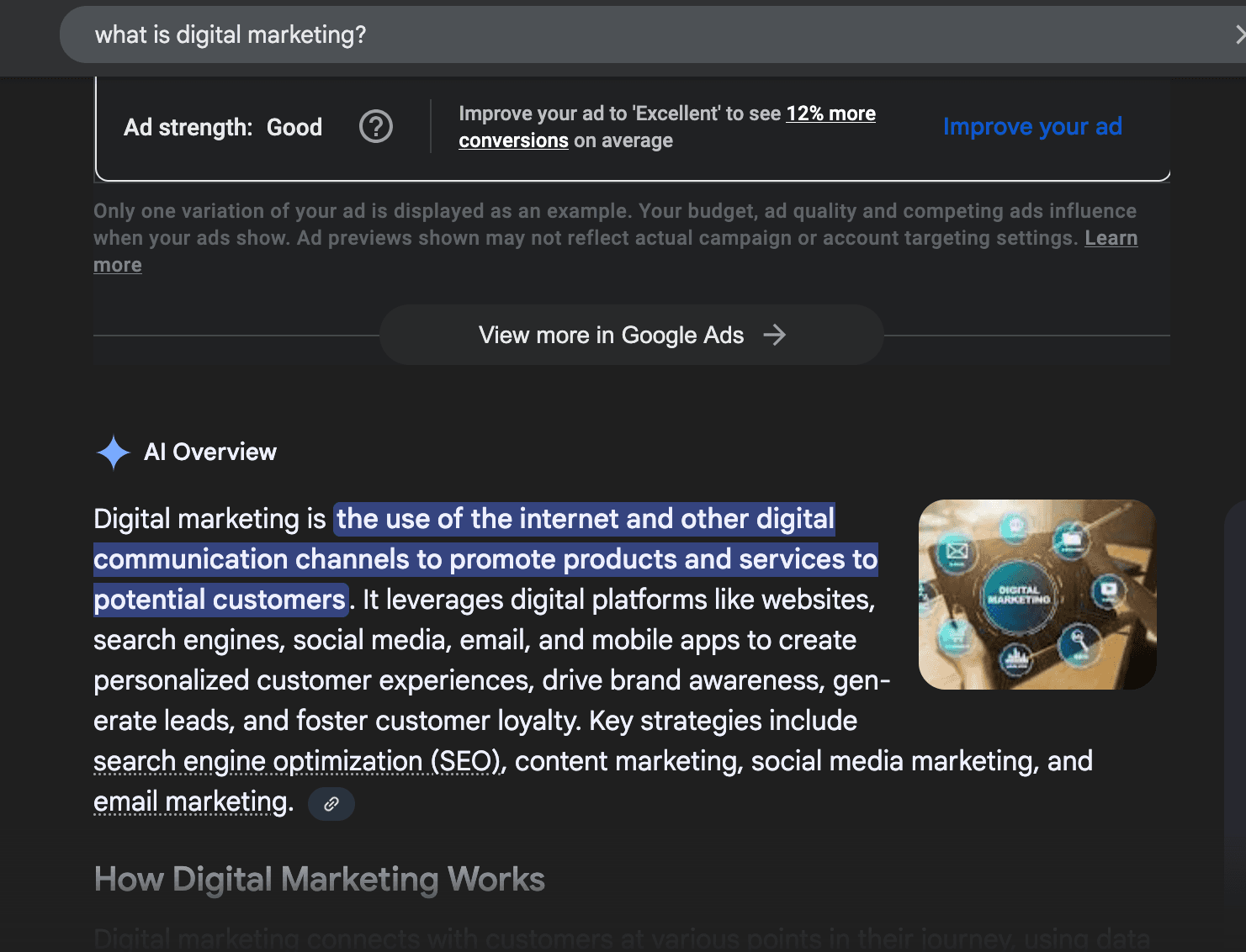
While handy, this does pose potential problems for SEO. If AI-generated results are taking over the SERPs, where does that leave your lead-generation strategy? Luckily, AI overviews are nothing without SEO, and you can use this new way of search to highlight your content at the very top of the page for relevant queries. See where the above example links to Wikipedia and Investopedia? That’s where you want to be.
SEO already incorporates strategies that blend seamlessly with AI search, including:
- Answering queries that your target audience is searching for
- Using searchable queries in your H tags
- Prioritising your domain authority (DA)
- Using structured data markup (Schema) to help Google’s AI tools understand your content
In terms of click-through rate (CTR), there are some worries that Google’s AI Overviews will lead to a pretty drastic drop. Current rates estimate a CTR decrease of around 35%, which isn’t ideal. However, we’ve seen these fears before, like when Google started optimising for mobile. Our advice? Keep calm, maintain a steady SEO strategy that works alongside AI overviews, and monitor your data.
E-E-A-T Content Is More Crucial Than Ever
With the rise of AI, Google needs to tackle AI-generated content that doesn’t add value for its users.
While their AI overviews can be useful, Google’s given us numerous signals that it wants user-focused, original content rather than AI copy-and-paste work. In particular, they’ve been highlighting the need for EEAT, which refers to content that displays:
- Experience: Real-world involvement with the topic, showing you have first-hand knowledge of the subject you’re discussing.
- Expertise: A high level of skill in the subject area, supported by qualifications and credentials, or a track record of producing accurate insights.
- Authoritativeness: Signals that you’re a reliable source within the field, such as your website’s DA, the number of links to your work, and the quality of insights provided.
- Trustworthiness: Transparency, honesty, and accuracy across your content, with clear trust signals that prove you’re a reliable source.
You might also hear EEAT used alongside ‘helpful content’. At its core, this is all about publishing content that brings value to your users, with answers to their questions that provide useful, original insights unique to your target market – not the sort of thing that AI is capable of.
Google’s Search Quality Rater Guidelines favour EEAT, and this focus is only set to increase as they work to separate AI-generated work from human-made content.
Google Business Profiles Remains a Priority
For a huge number of businesses, we’d highly recommend focusing a part of your SEO strategy on optimising your Google Business Profile (GBP). This is one of Google’s free tools that can skyrocket your CTR and search visibility, and is still trumping AI overviews when it comes to finding business locations.
It’s a fairly low-effort, high-reward strategy that delivers great ROI. It influences map rankings, mobile and desktop search visibility, and can even lead to direct calls and leads, making it a no-brainer for your digital marketing strategy.
As local search becomes increasingly important in the face of AI, maintaining your GBP will be more important than ever. Our top tips for seeing the best results include:
- Completing your profile with all applicable information, including a business address and contact details
- Updating your photos to reflect new products/services
- Asking your customers for reviews, and responding to those you receive
- Monitoring your Q&A
A dash of keyword optimisation never hurts, either, and will help you get noticed by the right audience.
User Experience is Increasingly Important
In line with EEAT, you now need to be delivering a seamless, user-focused experience from the very first interaction with your users.
In fact, this is one of the biggest changes to modern SEO. It’s crucial that you think beyond SERPs and keywords to design for the entire user journey, and that includes more platforms than just Google. This is because today’s search behaviour is so vast and fragmented, with users turning to AI chatbots and LLMs, social media, and forums just as frequently as they turn to search engines. The challenge (and opportunity) here lies in making sure your content is discoverable and valuable no matter where the user journey begins.
At GRM, we like to refer to this as a platform-agnostic approach to SEO. You’re meeting users where they are and providing an excellent user experience (UX) across platforms, creating a cohesive and consistent digital experience. Some of our key recommendations for platform-agnostic UX include:
- Prioritising digital accessibility and responsiveness
- Ensuring every piece of content you publish (from blogs to reels) adds value and feels purposeful
- Keeping your branding consistent regardless of where you are online
- Using keywords and formats optimised for different platforms to boost multi-channel SEO
- Creating a clear navigation path across channels, guiding towards a conversion
The takeaway? By prioritising relevance and ease of use in your digital strategy, alongside strong technical SEO, you’ll not only adapt to AI-driven search but also future-proof your brand for whatever changes come next.
For web development with a focus on UX, reach out to our award-winning developers.
Will SEO Still Be Relevant in 2026?
In short, yes! In fact, AI is actually making it more important than ever.
With widely accessible AI tools, brands can churn out generic content at lightning speeds, which levels the field in terms of quantity – but not quality. SEO strategies, like building backlinks and keyword research, ensure you’re not following generative AI trends by creating content that’s:
- Specific to your target market
- Draws on your individual experience to tick the boxes of EEAT content
- Attracting new backlinks and earning quotes in other publications
- Contributing to your website’s overall DA
- Targeting different audience segments with channel-specific content
While pushing you up the SERPs, focusing on high-quality SEO strategies also increases your likelihood of featuring in AI overviews.
It’s important to remember that AI and SERPs aren’t the be-all and end-all, too. With over 70% of UK consumers unsure whether to trust content as it could be AI (which opens a whole other story about negative public perceptions towards AI), it’s important that you stand out with an original voice. In a world of mass-produced content, users increasingly value natural UX, human connections, and brands that feel authentic.
Invest in Human-Led SEO Campaigns
At GRM, we understand that SEO is evolving. We know that there’s a place for AI in this new landscape, but we also believe digital marketing should be led by a human team. From engaging your target audience by learning more about what they’re searching for, to creating content that’s unmistakably yours, SEO is still a people-first strategy.
If you’re looking for a team to take over your SEO, we can help. With over a decade of experience and a team that’s consistently ahead of the curve, you can trust us to get your brand noticed online.
Learn more or kickstart your SEO strategy by reaching out to us today.